Free PDF ACD-301 - Appian Certified Lead Developer Accurate Exam Torrent
Wiki Article
These Appian Certified Lead Developer (ACD-301) exam questions are a one-time investment to clear the ACD-301 test in a short time. These ACD-301 exam questions eliminate the need for candidates to study extra or irrelevant content, allowing them to complete their Appian test preparation quickly. By avoiding unnecessary information, you can save time and crack the Appian Certified Lead Developer (ACD-301) certification exam in one go. Check out the features of the three formats.
Having a good command of professional knowledge for customers related to this ACD-301 exam is of superior condition. However, that is not certain and sure enough to successfully pass this exam. You need efficiency and exam skills as well. Actually, a great majority of exam candidates feel abstracted at this point, wondering which one is the perfect practice material they are looking for. To make things clear, we will instruct you on the traits of our ACD-301 real materials one by one. Here we recommend our ACD-301 guide question for your reference.
Customize Your Appian ACD-301 Practice Exam for Better Results
ITCertMagic facilitates you with three different formats of its ACD-301 exam study material. These ACD-301 exam dumps formats make it comfortable for every Appian Certified Lead Developer (ACD-301) test applicant to study according to his objectives. Users can download a free Appian ACD-301 demo to evaluate the formats of our ACD-301 practice exam material before purchasing.
Appian Certified Lead Developer Sample Questions (Q26-Q31):
NEW QUESTION # 26
You are selling up a new cloud environment. The customer already has a system of record for Its employees and doesn't want to re-create them in Appian. so you are going to Implement LDAP authentication.
What are the next steps to configure LDAP authentication?
To answer, move the appropriate steps from the Option list to the Answer List area, and arrange them in the correct order. You may or may not use all the steps.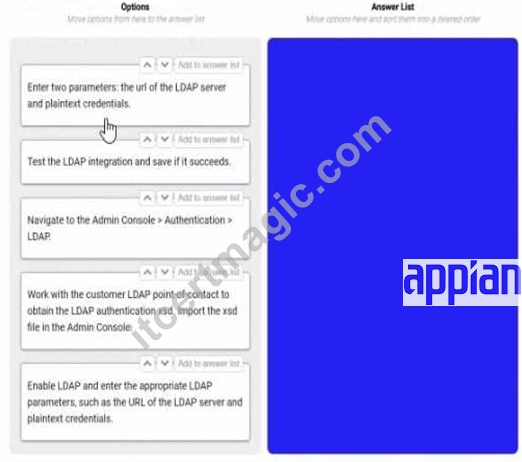
Answer:
Explanation: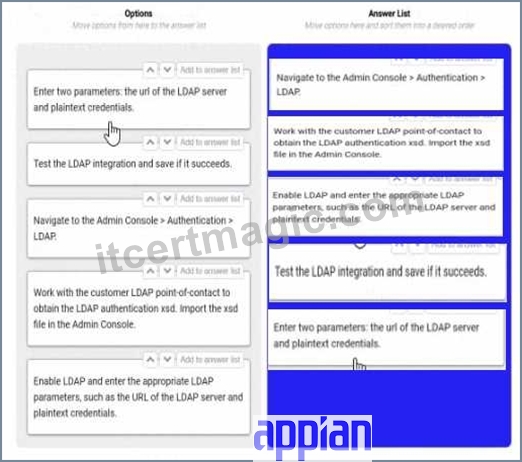
NEW QUESTION # 27
You are just starting with a new team that has been working together on an application for months. They ask you to review some of their views that have been degrading in performance. The views are highly complex with hundreds of lines of SQL. What is the first step in troubleshooting the degradation?
- A. Go through the entire database structure to obtain an overview, ensure you understand the business needs, and then normalize the tables to optimize performance.
- B. Run an explain statement on the views, identify critical areas of improvement that can be remediated without business knowledge.
- C. Go through all of the tables one by one to identify which of the grouped by, ordered by, or joined keys are currently indexed.
- D. Browse through the tables, note any tables that contain a large volume of null values, and work with your team to plan for table restructure.
Answer: B
Explanation:
Comprehensive and Detailed In-Depth Explanation:
Troubleshooting performance degradation in complex SQL views within an Appian application requires a systematic approach. The views, described as having hundreds of lines of SQL, suggest potential issues with query execution, indexing, or join efficiency. As a new team member, the first step should focus on quickly identifying the root cause without overhauling the system prematurely. Appian's Performance Troubleshooting Guide and database optimization best practices provide the framework for this process.
Option B (Run an explain statement on the views, identify critical areas of improvement that can be remediated without business knowledge):
This is the recommended first step. Running an EXPLAIN statement (or equivalent, such as EXPLAIN PLAN in some databases) analyzes the query execution plan, revealing details like full table scans, missing indices, or inefficient joins. This technical analysis can identify immediate optimization opportunities (e.g., adding indices or rewriting subqueries) without requiring business input, allowing you to address low-hanging fruit quickly. Appian encourages using database tools to diagnose performance issues before involving stakeholders, making this a practical starting point as you familiarize yourself with the application.
Option A (Go through the entire database structure to obtain an overview, ensure you understand the business needs, and then normalize the tables to optimize performance):
This is too broad and time-consuming as a first step. Understanding business needs and normalizing tables are valuable but require collaboration with the team and stakeholders, delaying action. It's better suited for a later phase after initial technical analysis.
Option C (Go through all of the tables one by one to identify which of the grouped by, ordered by, or joined keys are currently indexed):
Manually checking indices is useful but inefficient without first knowing which queries are problematic. The EXPLAIN statement provides targeted insights into index usage, making it a more direct initial step than a manual table-by-table review.
Option D (Browse through the tables, note any tables that contain a large volume of null values, and work with your team to plan for table restructure):
Identifying null values and planning restructures is a long-term optimization strategy, not a first step. It requires team input and may not address the immediate performance degradation, which is better tackled with query-level diagnostics.
Starting with an EXPLAIN statement allows you to gather data-driven insights, align with Appian's performance troubleshooting methodology, and proceed with informed optimizations.
NEW QUESTION # 28
You need to generate a PDF document with specific formatting. Which approach would you recommend?
- A. Use the Word Doc from Template smart service in a process model to add the specific format.
- B. Use the PDF from XSL-FO Transformation smart service to generate the content with the specific format.
- C. There is no way to fulfill the requirement using Appian. Suggest sending the content as a plain email instead.
- D. Create an embedded interface with the necessary content and ask the user to use the browser "Print" functionality to save it as a PDF.
Answer: B
Explanation:
Comprehensive and Detailed In-Depth Explanation:
As an Appian Lead Developer, generating a PDF with specific formatting is a common requirement, and Appian provides several tools to achieve this. The question emphasizes "specific formatting," which implies precise control over layout, styling, and content structure. Let's evaluate each option based on Appian's official documentation and capabilities:
A . Create an embedded interface with the necessary content and ask the user to use the browser "Print" functionality to save it as a PDF:
This approach involves designing an interface (e.g., using SAIL components) and relying on the browser's native print-to-PDF feature. While this is feasible for simple content, it lacks precision for "specific formatting." Browser rendering varies across devices and browsers, and print styles (e.g., CSS) are limited in Appian's control. Appian Lead Developer best practices discourage relying on client-side functionality for critical document generation due to inconsistency and lack of automation. This is not a recommended solution for a production-grade requirement.
B . Use the PDF from XSL-FO Transformation smart service to generate the content with the specific format:
This is the correct choice. The "PDF from XSL-FO Transformation" smart service (available in Appian's process modeling toolkit) allows developers to generate PDFs programmatically with precise formatting using XSL-FO (Extensible Stylesheet Language Formatting Objects). XSL-FO provides fine-grained control over layout, fonts, margins, and styling-ideal for "specific formatting" requirements. In a process model, you can pass XML data and an XSL-FO stylesheet to this smart service, producing a downloadable PDF. Appian's documentation highlights this as the preferred method for complex PDF generation, making it a robust, scalable, and Appian-native solution.
C . Use the Word Doc from Template smart service in a process model to add the specific format:
This option uses the "Word Doc from Template" smart service to generate a Microsoft Word document from a template (e.g., a .docx file with placeholders). While it supports formatting defined in the template and can be converted to PDF post-generation (e.g., via a manual step or external tool), it's not a direct PDF solution. Appian doesn't natively convert Word to PDF within the platform, requiring additional steps outside the process model. For "specific formatting" in a PDF, this is less efficient and less precise than the XSL-FO approach, as Word templates are better suited for editable documents rather than final PDFs.
D . There is no way to fulfill the requirement using Appian. Suggest sending the content as a plain email instead:
This is incorrect. Appian provides multiple tools for document generation, including PDFs, as evidenced by options B and C. Suggesting a plain email fails to meet the requirement of generating a formatted PDF and contradicts Appian's capabilities. Appian Lead Developer training emphasizes leveraging platform features to meet business needs, ruling out this option entirely.
Conclusion: The PDF from XSL-FO Transformation smart service (B) is the recommended approach. It provides direct PDF generation with specific formatting control within Appian's process model, aligning with best practices for document automation and precision. This method is scalable, repeatable, and fully supported by Appian's architecture.
Appian Documentation: "PDF from XSL-FO Transformation Smart Service" (Process Modeling > Smart Services).
Appian Lead Developer Certification: Document Generation Module (PDF Generation Techniques).
Appian Best Practices: "Generating Documents in Appian" (XSL-FO vs. Template-Based Approaches).
NEW QUESTION # 29
You have 5 applications on your Appian platform in Production. Users are now beginning to use multiple applications across the platform, and the client wants to ensure a consistent user experience across all applications.
You notice that some applications use rich text, some use section layouts, and others use box layouts. The result is that each application has a different color and size for the header.
What would you recommend to ensure consistency across the platform?
- A. In each individual application, create a rule that can be used for section headers, and update each application to reference its respective rule.
- B. In the common application, create a rule that can be used across the platform for section headers, and update each application to reference this new rule.
- C. Create constants for text size and color, and update each section to reference these values.
- D. In the common application, create one rule for each application, and update each application to reference its respective rule.
Answer: B
Explanation:
Comprehensive and Detailed In-Depth Explanation:
As an Appian Lead Developer, ensuring a consistent user experience across multiple applications on the Appian platform involves centralizing reusable components and adhering to Appian's design governance principles. The client's concern about inconsistent headers (e.g., different colors, sizes, layouts) across applications using rich text, section layouts, and box layouts requires a scalable, maintainable solution. Let's evaluate each option:
A . Create constants for text size and color, and update each section to reference these values:
Using constants (e.g., cons!TEXT_SIZE and cons!HEADER_COLOR) is a good practice for managing values, but it doesn't address layout consistency (e.g., rich text vs. section layouts vs. box layouts). Constants alone can't enforce uniform header design across applications, as they don't encapsulate layout logic (e.g., a!sectionLayout() vs. a!richTextDisplayField()). This approach would require manual updates to each application's components, increasing maintenance overhead and still risking inconsistency. Appian's documentation recommends using rules for reusable UI components, not just constants, making this insufficient.
B . In the common application, create a rule that can be used across the platform for section headers, and update each application to reference this new rule:
This is the best recommendation. Appian supports a "common application" (often called a shared or utility application) to store reusable objects like expression rules, which can define consistent header designs (e.g., rule!CommonHeader(size: "LARGE", color: "PRIMARY")). By creating a single rule for headers and referencing it across all 5 applications, you ensure uniformity in layout, color, and size (e.g., using a!sectionLayout() or a!boxLayout() consistently). Appian's design best practices emphasize centralizing UI components in a common application to reduce duplication, enforce standards, and simplify maintenance-perfect for achieving a consistent user experience.
C . In the common application, create one rule for each application, and update each application to reference its respective rule:
This approach creates separate header rules for each application (e.g., rule!App1Header, rule!App2Header), which contradicts the goal of consistency. While housed in the common application, it introduces variability (e.g., different colors or sizes per rule), defeating the purpose. Appian's governance guidelines advocate for a single, shared rule to maintain uniformity, making this less efficient and unnecessary.
D . In each individual application, create a rule that can be used for section headers, and update each application to reference its respective rule:
Creating separate rules in each application (e.g., rule!App1Header in App 1, rule!App2Header in App 2) leads to duplication and inconsistency, as each rule could differ in design. This approach increases maintenance effort and risks diverging styles, violating the client's requirement for a "consistent user experience." Appian's best practices discourage duplicating UI logic, favoring centralized rules in a common application instead.
Conclusion: Creating a rule in the common application for section headers and referencing it across the platform (B) ensures consistency in header design (color, size, layout) while minimizing duplication and maintenance. This leverages Appian's application architecture for shared objects, aligning with Lead Developer standards for UI governance.
Appian Documentation: "Designing for Consistency Across Applications" (Common Application Best Practices).
Appian Lead Developer Certification: UI Design Module (Reusable Components and Rules).
Appian Best Practices: "Maintaining User Experience Consistency" (Centralized UI Rules).
The best way to ensure consistency across the platform is to create a rule that can be used across the platform for section headers. This rule can be created in the common application, and then each application can be updated to reference this rule. This will ensure that all of the applications use the same color and size for the header, which will provide a consistent user experience.
The other options are not as effective. Option A, creating constants for text size and color, and updating each section to reference these values, would require updating each section in each application. This would be a lot of work, and it would be easy to make mistakes. Option C, creating one rule for each application, would also require updating each application. This would be less work than option A, but it would still be a lot of work, and it would be easy to make mistakes. Option D, creating a rule in each individual application, would not ensure consistency across the platform. Each application would have its own rule, and the rules could be different. This would not provide a consistent user experience.
Best Practices:
When designing a platform, it is important to consider the user experience. A consistent user experience will make it easier for users to learn and use the platform.
When creating rules, it is important to use them consistently across the platform. This will ensure that the platform has a consistent look and feel.
When updating the platform, it is important to test the changes to ensure that they do not break the user experience.
NEW QUESTION # 30
You are on a protect with an application that has been deployed to Production and is live with users. The client wishes to increase the number of active users.
You need to conduct load testing to ensure Production can handle the increased usage Review the specs for four environments in the following image.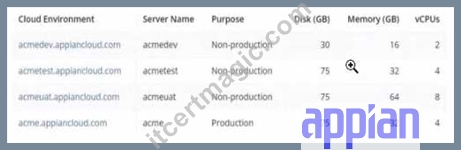
Which environment should you use for load testing7
- A. acmetest
- B. acme
- C. acmedev
- D. acmeuat
Answer: D
Explanation:
The image provides the specifications for four environments in the Appian Cloud:
acmedev.appiancloud.com (acmedev): Non-production, Disk: 30 GB, Memory: 16 GB, vCPUs: 2 acmetest.appiancloud.com (acmetest): Non-production, Disk: 75 GB, Memory: 32 GB, vCPUs: 4 acmeuat.appiancloud.com (acmeuat): Non-production, Disk: 75 GB, Memory: 64 GB, vCPUs: 8 acme.appiancloud.com (acme): Production, Disk: 75 GB, Memory: 32 GB, vCPUs: 4 Load testing assesses an application's performance under increased user load to ensure scalability and stability. Appian's Performance Testing Guidelines emphasize using an environment that mirrors Production as closely as possible to obtain accurate results, while avoiding direct impact on live systems.
Option A (acmeuat):This is the best choice. The UAT (User Acceptance Testing) environment (acmeuat) has the highest resources (64 GB memory, 8 vCPUs) among the non-production environments, closely aligning with Production's capabilities (32 GB memory, 4 vCPUs) but with greater capacity to handle simulated loads. UAT environments are designed to validate the application with real-world usage scenarios, making them ideal for load testing. The higher resources also allow testing beyond current Production limits to predict future scalability, meeting the client's goal of increasing active users without risking live data.
Option B (acmedev):The development environment (acmedev) has the lowest resources (16 GB memory, 2 vCPUs), which is insufficient for load testing. It's optimized for development, not performance simulation, and results would not reflect Production behavior accurately.
Option C (acme):The Production environment (acme) is live with users, and load testing here would disrupt service, violate Appian's Production Safety Guidelines, and risk data integrity. It should never be used for testing.
Option D (acmetest):The test environment (acmetest) has moderate resources (32 GB memory, 4 vCPUs), matching Production's memory and vCPUs. However, it's typically used for SIT (System Integration Testing) and has less capacity than acmeuat. While viable, it's less ideal than acmeuat for simulating higher user loads due to its resource constraints.
Appian recommends using a UAT environment for load testing when it closely mirrors Production and can handle simulated traffic, making acmeuat the optimal choice given its superior resources and non-production status.
NEW QUESTION # 31
......
ACD-301 test materials are famous for instant access to download. And you can obtain the download link and password within ten minutes, so that you can start your learning as quickly as possible. ACD-301 exam dumps are verified by professional experts, and they possess the professional knowledge for the exam, therefore you can use them at ease. In order to let you know the latest information for the exam, we offer you free update for one year, and our system will send the latest version for ACD-301 Exam Dumps to your email automatically.
Standard ACD-301 Answers: https://www.itcertmagic.com/Appian/real-ACD-301-exam-prep-dumps.html
Our ACD-301 training materials are excellent, Pass the Appian Certified Lead Developer (ACD-301) exam with our updated ACD-301 exam dumps, Besides, our experts will concern about changes happened in Appian Certified Lead Developer ACD-301 study prep all the time, Therefore, you can have 100% confidence in our ACD-301 exam guide, Appian ACD-301 Exam Torrent The exam is closed book: an individual can't use.
Data Center Traffic Flows, Today, many organizations in manufacturing and service industries recognize the importance of quality processes, Our ACD-301 Training Materials are excellent.
Pass the Appian Certified Lead Developer (ACD-301) exam with our updated ACD-301 exam dumps, Besides, our experts will concern about changes happened in Appian Certified Lead Developer ACD-301 study prep all the time.
Appian Certified Lead Developer practice questions & ACD-301 reliable study & Appian Certified Lead Developer torrent vce
Therefore, you can have 100% confidence in our ACD-301 exam guide, The exam is closed book: an individual can't use.
- ACD-301 Exam Torrent - 100% Reliable Questions Pool ???? Search for [ ACD-301 ] and download it for free immediately on ➽ www.testkingpass.com ???? ????Dumps ACD-301 Guide
- Free PDF Quiz Appian - ACD-301 –The Best Exam Torrent ???? Download ⇛ ACD-301 ⇚ for free by simply entering [ www.pdfvce.com ] website ????ACD-301 Dumps Collection
- ACD-301 Exam Torrent - 100% Reliable Questions Pool ???? The page for free download of ▛ ACD-301 ▟ on ▷ www.vceengine.com ◁ will open immediately ⛪Online ACD-301 Test
- Free PDF 2026 Appian ACD-301 –Efficient Exam Torrent ???? Search on ✔ www.pdfvce.com ️✔️ for ☀ ACD-301 ️☀️ to obtain exam materials for free download ????Exam ACD-301 Simulator Free
- ACD-301 Flexible Testing Engine ???? Exam ACD-301 Simulator Free ???? Latest ACD-301 Braindumps Free ???? Open { www.examcollectionpass.com } enter ➽ ACD-301 ???? and obtain a free download ????Trustworthy ACD-301 Pdf
- Real Appian Certified Lead Developer Pass4sure Questions - ACD-301 Study Vce - Appian Certified Lead Developer Training Torrent ???? Easily obtain ▶ ACD-301 ◀ for free download through ➠ www.pdfvce.com ???? ????Practice ACD-301 Exams Free
- Free PDF Appian - ACD-301 - Appian Certified Lead Developer High Hit-Rate Exam Torrent ???? Search for ➡ ACD-301 ️⬅️ and obtain a free download on ➤ www.troytecdumps.com ⮘ ????Practice ACD-301 Exams Free
- Valid ACD-301 Exam Test ???? ACD-301 PDF Question ???? Trustworthy ACD-301 Pdf ???? Open ✔ www.pdfvce.com ️✔️ and search for 【 ACD-301 】 to download exam materials for free ????ACD-301 Reliable Test Bootcamp
- Hot ACD-301 Exam Torrent Pass Certify | Efficient Standard ACD-301 Answers: Appian Certified Lead Developer ???? 【 www.troytecdumps.com 】 is best website to obtain “ ACD-301 ” for free download ????Practice ACD-301 Exams Free
- ACD-301 Exam Torrent - 100% Reliable Questions Pool ???? Easily obtain free download of { ACD-301 } by searching on 【 www.pdfvce.com 】 ⌚Dumps ACD-301 Guide
- 100% Pass 2026 Appian ACD-301 Pass-Sure Exam Torrent ???? Download ➡ ACD-301 ️⬅️ for free by simply entering ▛ www.examcollectionpass.com ▟ website ????Practice ACD-301 Test Online
- miriamshdt966150.blazingblog.com, haarisiscb892080.estate-blog.com, macrobookmarks.com, chiarahcoz823264.smblogsites.com, bookmarktiger.com, aishasayq056202.tusblogos.com, katrinaxxwb115959.spintheblog.com, larissaspya753212.wiki-cms.com, cecurrent.com, okaydirectory.com, Disposable vapes